
How CXWolf scores an agent
Most evaluation tools measure whether an AI agent got the answer right. CXWolf measures something adjacent and largely ignored: whether the interaction felt human. Here's exactly how.
Where the validation data actually comes from
This isn't one afternoon of testing. Over the past two years, I've called and evaluated AI voice and chat agents across 25+ companies in the United States, using publicly available numbers, the same way any customer would encounter them. Each interaction was scored independently by human raters against the same criteria: did this feel like a person, and where exactly did it stop feeling that way.
That raw data, built up interaction by interaction, is what Text Score and Voice Score are calibrated against. Not a guess about what “sounds human” should mean. A pattern, built from real calls, real transcripts, and real human judgment, applied consistently.
Two separate axes
Correctness and human-ness are independent variables. An agent can give the exactly right answer in a way that feels mechanical, over-formal, or subtly wrong in rhythm. Another agent can sound completely natural while getting details wrong.
CXWolf reports these separately rather than folding them into one blended quality score, because teams need to know which problem they actually have before they can fix it.
Text Score
Text Score evaluates the transcript on its own. It looks at word choice, phrasing, sentence rhythm, and conversational pacing, the way a careful reader would judge whether a piece of writing sounds like a person or a script.
It catches the tells that make chat and voice transcripts read as artificial even when every fact in them is correct: rigid sentence templates, over-explaining, unnatural politeness patterns, and phrasing no person would actually use in conversation.
Specifically
Canned-phrase density, register match, repetition, sentence rhythm, hedging calibration, turn-taking, empathy placement, tone-shift response, plain-language fit, and certainty calibration.
Voice Score
Voice Score evaluates the same interaction as audio. It looks at prosody, pacing, pause placement, and delivery. This is where text-to-speech pipelines most often break the illusion, even when the underlying script reads perfectly well on paper.
A transcript can pass Text Score cleanly and still fail Voice Score if the synthesized delivery is flat, rushed, or mistimed. Teams building voice agents on Vapi, Retell, or Bland need both numbers, not one.
Specifically
Pause placement, speaking-rate variance, pitch and intonation (F0) range, response latency, acoustic empathy shift, breath and disfluency patterns, and overall naturalness. Response latency is the one item here with a published, industry-agreed benchmark. Everything else has no existing standard, which is not a gap in the research, it's the reason this hasn't been built yet.
Understanding why an agent sounds robotic meant going past the obvious, pace and word choice, into the layer underneath: prosody, response latency, pitch variance, the same territory linguists and speech scientists study in human-to-human conversation. Most AI evaluation stops at “did it answer correctly.” This goes further because customer experiencealways has.
Here's what that breakdown actually looks like once a report comes back. Notice the pattern: word choice and sentence rhythm score high, but prosody and pause placement lag well behind. That gap is the actual diagnosis. It tells a team the language model is doing its job, the problem is downstream in how the text gets converted to speech, which means the fix is a TTS or voice pipeline change, not a prompt rewrite. A single blended score would have hidden exactly which layer to fix.
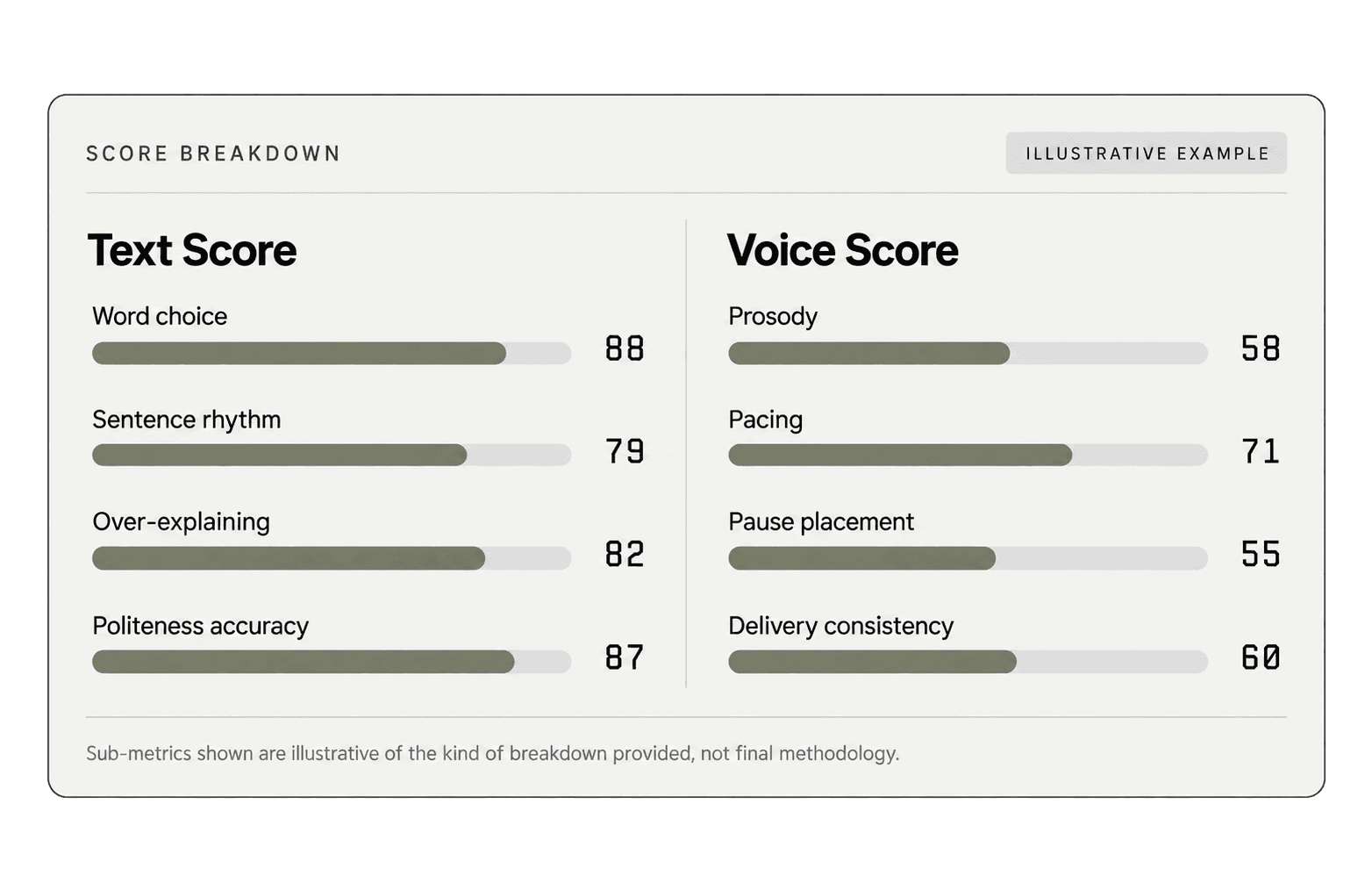
Sub-metrics point at the specific fix, not just the general problem.
Validated against humans
Both scores are calibrated against ratings collected from real human raters, not from another model judging the output. This is the step most AI-evaluation tools skip, because it's slower and more expensive than having a second model grade the first one.
Without that grounding, an evaluation score just tells you what a model thinks sounds human, which is a different, much less useful, question.
Get early access before public launch
Named after the only guy in the room who stayed calm when everything was on fire.